
THE RULE
What is the 10 20 30 rule?
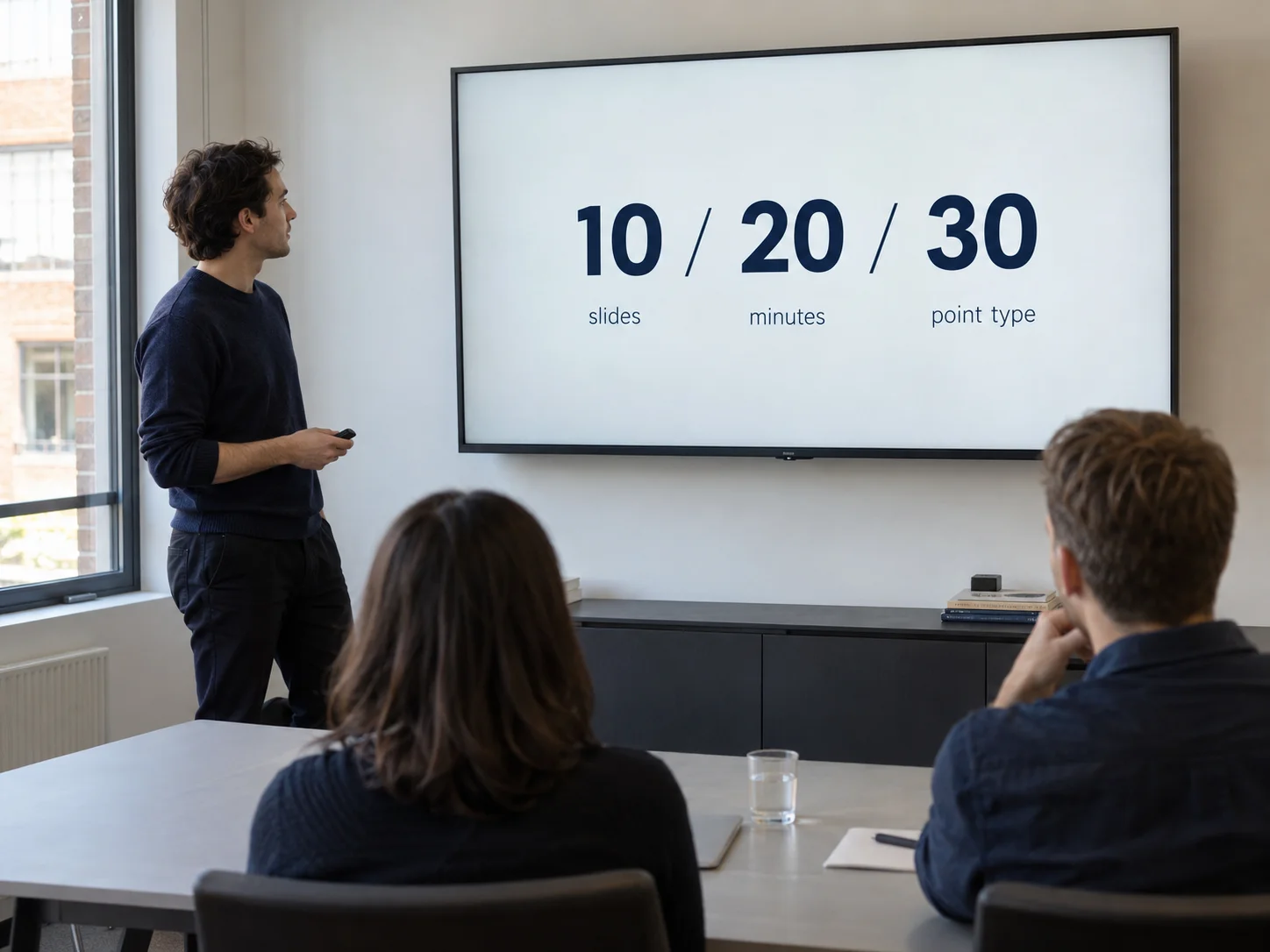
The 10 20 30 rule means 10 slides, no more than 20 minutes, and a minimum 30-point font. Guy Kawasaki introduced it as a way to keep a pitch focused.
Choose what belongs in the pitch. Keep the rest in an appendix.
20 minutesFinish within twenty minutes so there’s time for questions.
30-point typeKeep text large enough to read without crowding the slide.
Use the slides to support what you’re saying. Put detailed explanations in your speaker notes, where they won’t compete for the audience’s attention.
EXAMPLE DECK
A ten-slide pitch deck example
This example is for an invoicing service used by small agencies. It covers the customer problem, the service, pricing, sales, and a funding request. Select a slide to see the example and its speaker notes.

Speaker notes
Our initial customer is a 10–30 person agency. In this illustrative scenario, its operations lead spends six hours each week reconciling time logs and chasing approvals before invoices can go out.
The business, figures, and team in this example are fictional. The slide previews are scaled to fit your screen.
SLIDE CONTENT
What to put on each slide
The outline below follows the topics in the original framework. Open a section for an example headline, writing advice, and the evidence you’ll need.
Explain where the numbers come from
In this example, 40 agencies × $200 = $8,000 MRR. The audience can see how the customer count and subscription price produce the revenue figure.
The second bar shows the target: 100 agencies and $20,000 MRR. Label it clearly so nobody mistakes a projection for current revenue.
The striped bar is a target. ↖Use a specific heading, such as “40 paying agencies,” instead of “Traction.” If you haven’t started charging customers, show measured progress such as active trials or completed pilots.
Where should market size go?
Describe your target customer in the problem and sales slides. If market size needs a separate explanation, give it a slide and combine two shorter topics elsewhere.
TIMING
How to plan a twenty-minute pitch
You don’t have to spend two minutes on every slide. A team introduction may take one minute; explaining the financial plan may take three. The schedule below adds up to twenty minutes.
In a one-hour meeting, a twenty-minute pitch leaves forty minutes for questions. Adjust this split to your actual meeting length.
See the slide-by-slide timing 20:00 total +
- 01The problem2:00
- 02Your solution2:00
- 03How you make money1:30
- 04What makes it work2:00
- 05Finding customers2:00
- 06Customer alternatives1:30
- 07The people1:00
- 08Numbers and milestones3:00
- 09Progress and next steps2:00
- 10The ask3:00
Time a full rehearsal
Present the deck aloud with a timer, including any demo. If you run over, remove a secondary point or move it to the appendix. Prepare a shorter version in case the meeting starts late.
Only have twenty minutes for the entire meeting? Try a 10–12 minute pitch and leave the rest for questions.
FONT SIZE
Use at least 30-point text
Set your body text to at least 30 pt in the presentation editor. If the slide becomes too crowded, shorten the text or move the explanation into your notes. This example shows how to simplify a slide.
How the invoicing service works
The service collects time entries from each project and checks that the work has been approved. The operations lead reviews any missing details or changed entries, prepares the invoice, checks it against the client agreement, and sends it. Payment reminders are queued after sending. The team can check the status of each invoice in the same place.
Time tracking · Approvals · Reconciliation · Follow-upsThe audience has to read a paragraph while you’re speaking.
The slide shows the three steps. You explain the details aloud.
Move the feature list
into your notes.
Replace the vague headline
with an outcome.
Show the workflow
in three steps.
Check chart labels, too. Share your screen and look at it on a smaller laptop. If someone needs to squint, simplify the chart or increase the type. A 30-point setting alone doesn’t guarantee readability.
EXCEPTIONS
When to adjust the rule
Ten slides and twenty minutes won’t suit every presentation. Adjust the format when the meeting calls for it.
Use fewer slides and rehearse within the event’s time limit. Include the problem, your strongest evidence, and what you’re asking for.
Include enough explanation for someone to understand the deck without hearing you present it.
Keep the overview short. Put architecture, validation, and detailed data in an appendix or a separate session.
If an investor or event asks for a particular format, follow it. You can still keep the text readable and the presentation concise.
DOWNLOADS AND REFERENCES
Pitch deck resources
Download the ten-slide outline
A text file with a writing prompt, suggested timing, and an evidence checklist for each slide.
Plain text · Editable in any document app · No signup
The original 10/20/30 article
Guy Kawasaki’s explanation of the slide count, time limit, and font size.
Read the article ↗THE FOLLOW-UP / SLIDE REFERENCEThe author’s slide template
A follow-up article with a presentation template and advice on the ten-slide format.
See the reference ↗QUESTIONS
Frequently asked questions
What is the 10 20 30 rule?
It is Guy Kawasaki's presentation guideline: ten slides, a maximum of twenty minutes, and a minimum font size of thirty points. It gives you a simple starting structure for a concise live pitch.
Who created the 10/20/30 rule?
Guy Kawasaki introduced the rule in a 2005 article about business presentations. His original explanation focuses on venture pitches and also mentions sales and partnership presentations.
Does the title slide count toward the ten slides?
If you present it as a separate slide, count it. In the example on this page, the opening problem slide also serves as the introduction. You can use a dedicated cover, but combine or reorganize another topic to keep a ten-slide core.
Are the twenty minutes just for the pitch or also for questions?
The twenty minutes refers to the presentation. Leave additional time for discussion when the meeting allows it. If the entire meeting is twenty minutes, make your prepared pitch shorter so questions still fit.
Does every slide need exactly two minutes?
No. Twenty minutes across ten slides is an average. Spend more time on the evidence and decisions that matter, and move quickly through simple context. This guide includes a sample timing plan that adds up to twenty minutes.
Can I include more than ten slides?
You can adapt the guideline to the audience and the meeting. Keep supporting material in an appendix and open it when relevant. If an investor or event asks for a particular format, use that format instead of forcing the ten-slide structure.
Should a deck sent by email follow the same rule?
A deck that someone reads without you needs enough context to stand on its own. Keep it concise and legible, but add explanations where the live version relies on your narration. The twenty-minute speaking limit does not apply to an asynchronous document.
Is 30-point text always readable?
No. Thirty points is a starting constraint, not a guarantee of accessibility. Contrast, font choice, room size, screen sharing, and viewing distance all matter. Test the actual presentation setup and increase the size when needed.